
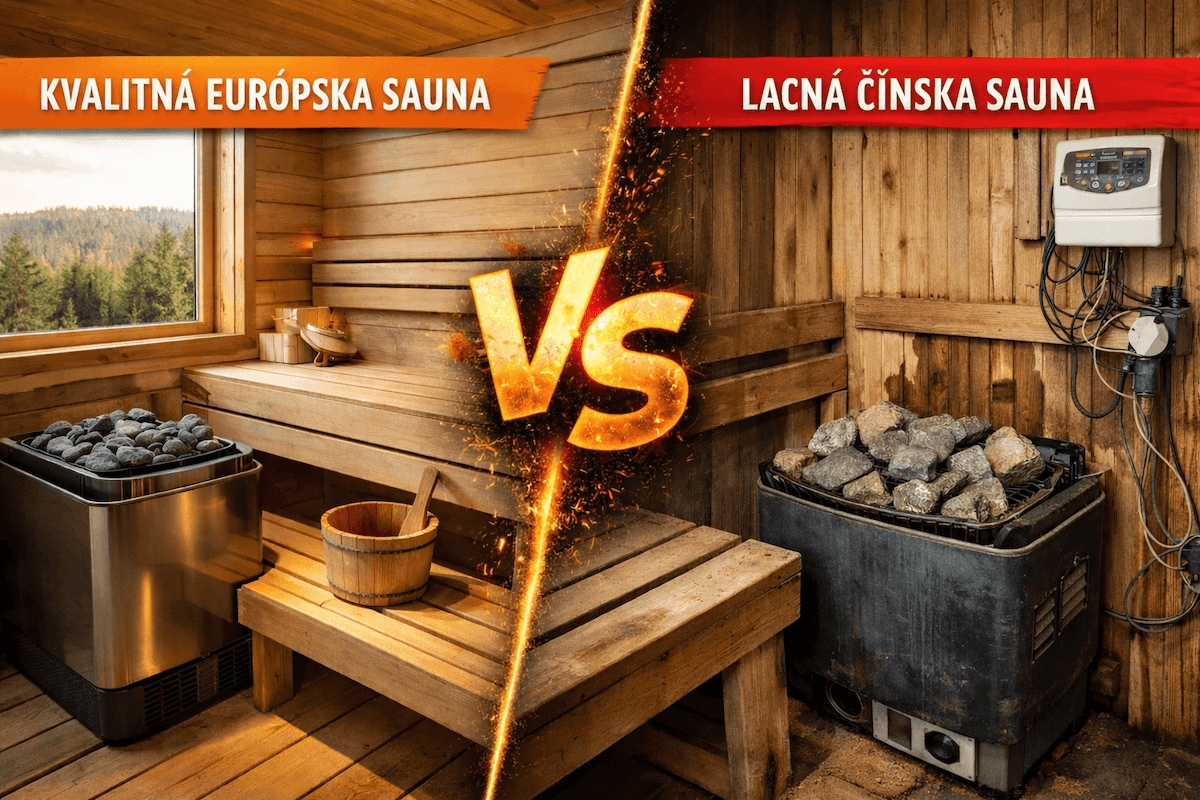
A sauna is a structural element that creates a controlled environment for systematic body regeneration. The quality of this environment depends on materials, craftsmanship, and technical design. These factors determine whether a sauna fulfils its function for five years or twenty-five.
The following comparison systematically analyses the differences between European solutions built on engineering principles and mass-produced units available at a lower initial price.
Timber is the primary structural material in a sauna. Its quality directly affects stability, health safety, and long-term functionality of the entire system.
Quality European manufacturers use certified timber species — Nordic spruce, pine, aspen, or thermally modified wood with controlled processing. Drying is carried out uniformly, ensuring low residual moisture and minimal dimensional variance. Profiles are milled with precision that allows exact tongue-and-groove alignment. Surface treatment is applied only in zones where it is safe at temperatures above 80 °C.
The result is material integrity that deepens over time — the wood ages uniformly and retains its structural stability.
Mass-produced units often use lower-grade timber, rapidly dried lumber, composite materials, and laminated layers. The initial visual impression may be acceptable. After one or two seasons, however, cracks, warping, and loosened joints appear — a direct consequence of inadequate material preparation.
European manufacturers prioritise precise cuts, quality seals, multi-layer panels, vapour barriers, and thermal insulation designed for the specific cabin volume. Many test the sauna during the manufacturing process — through trial heating and leak inspection. This directly translates into faster heat-up, uniform temperature distribution, lower energy consumption, and minimised condensation.
Mass-produced units are delivered as standardised modules with wider manufacturing tolerances. Insulation tends to be thinner, seals less precise, and assembly requires manual adjustment of details. The consequence is higher energy demand and uneven temperature distribution within the cabin.
The heating system is the functional core of a sauna. Its reliability and precise regulation determine the quality of the regenerative environment.
Quality saunas use heaters from manufacturers with a proven track record — such as Harvia or EOS Saunatechnik. These systems undergo safety testing, hold CE and EN certifications, utilise reliable resistive elements, and allow precise temperature regulation. Power output is dimensioned to match the actual cabin volume.
Mass-produced heaters often lack a clear certification history, feature control panels with limited durability, and have improperly dimensioned output. This leads to slower heat-up, more frequent failures, and higher service costs. An inadequately dimensioned heating system also presents a structural safety concern.
Quality manufacturers comply with CE, EN, and EMC safety standards. They use quality cabling, protective elements, and provide complete technical documentation. Current EU certification requirements can be verified on the European Commission website (single-market-economy.ec.europa.eu).
Some imported products carry markings that lack full certification validity. Documentation is often incomplete, and installation without expert supervision may pose risks of overheating or short-circuiting. Electrical installation is an area where precise compliance with standards is a prerequisite for safe operation.
European saunas are designed as complete systems. Vapour barriers, ventilation, and floor solutions are integrated into the project, minimising condensation even in demanding conditions.
Mass-produced units assume ideal conditions. In reality — humidity, temperature fluctuations, insufficient air circulation — mould, odour, and timber degradation may occur. Quality insulation directly determines long-term functionality and hygienic safety.
Professional installation by a certified team, local service support, clearly defined warranty terms, and available spare parts. Service infrastructure is equally important as the construction quality itself — it ensures continuity of function throughout the product’s lifespan.
Flat-pack delivery, assembly by non-specialist teams, complicated claims processes, and extended logistics times. The absence of local service support may result in prolonged operational downtime.
European manufacturers routinely provide technical data sheets, verifiable installation references, showrooms, and documented project portfolios. With mass-produced products, certifications tend to be generic or unverifiable.
RECOMMENDATION
Always request insulation testing, fire safety assessment, and verifiable references of completed installations. Documentation transparency is a direct indicator of construction quality.
European solutions offer individual design tailored to a specific architectural environment, quality glazing, OEM configurations, and higher residual value. Integrating a sauna into an existing space is a structural project, not a catalogue selection. Mass production offers limited style variants and reduced variability, which constrains the possibilities for architectural integration.
Before selecting a supplier, verify the following criteria:
The difference between a European engineered solution and a mass-produced unit is not merely a matter of price. It lies in material certification, construction precision, safety standards, and long-term functionality.
A stable regenerative environment requires a stable construction. This is a prerequisite, not a premium add-on.