Sauna Quality and Lifespan: Wood for Sauna Construction, Insulation, Heater and Care
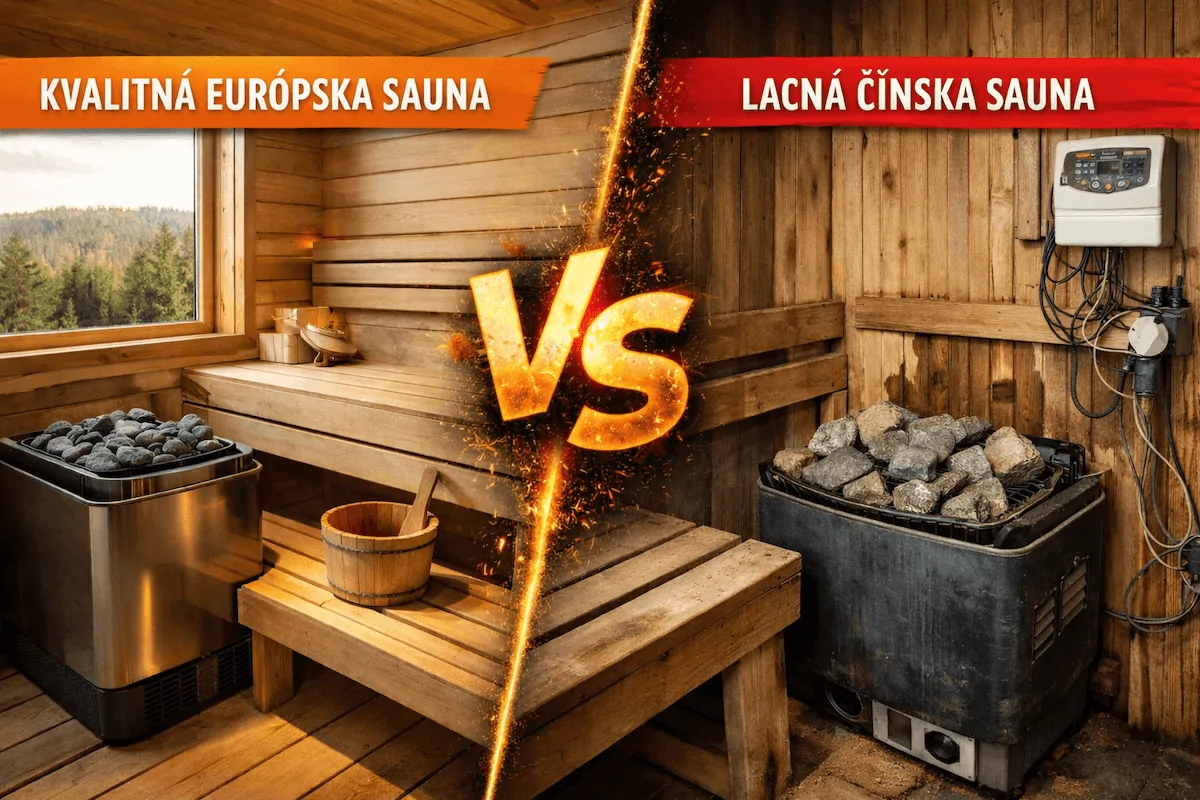
Sauna quality – from the wood for sauna construction to the insulation – cannot be judged by price or by country of origin. It can be verified, and it is what determines how long a sauna lasts. The decisive factors are the timber species and its durability, the wall and insulation build-up, the roof and base, a documented heater, the electrical installation, ventilation and available servicing. No standard sets a lifespan in years for a sauna. Timber durability, however, is measurable: under EN 350, spruce is in class 4, larch in class 3–4 and thermowood, depending on the degree of heat treatment, in class 2–3. The seller should be able to document the other parameters for a specific model. If they cannot, that is information in itself.
The heater, stones and seals are replaceable parts. Whether a sauna needs renovation after some years is decided by its load-bearing structure. That structure is protected by a dry base, a sound roof, ventilation and regular care.
For completeness: LUXURELAX does not manufacture saunas – we sell, install and service them. Our catalogue models are also series-produced. The difference between an engineering approach and mass production therefore lies not in the number of units, but in the specification.
Sauna quality at a glance: what to verify and what affects lifespan
| Parameter | What to verify when buying | What extends the lifespan | Risk if the parameter is not documented |
|---|---|---|---|
| Cladding timber | species, durability class under EN 350, treatment | thermowood treated with a UV-filter oil, or spruce with a regularly renewed coating | unknown species, fast-dried beams, laminated layers without data |
| Wall and insulation | wall thickness, type and thickness of insulation in the walls, roof and floor | a solid wall with re-tightenable joints, or an insulated frame with outer cladding | a thin wall with no stated thickness, insulation in the walls only |
| Roof | type of roofing and roof shape | shingles or metal roofing without surfaces where water stands | leaks, water and snow lying on flat surfaces |
| Base | the seller’s requirements for the base | a firm, level base with space for ventilation underneath | a sauna placed directly on damp ground |
| Heater | manufacturer, output in kW relative to cabin volume, standard | a heater from an established manufacturer sized to the volume, regular stone checks | a heater without documentation, a “universal” output |
| Electrical installation | heat-resistant wiring, documentation, connection by a professional | a complete installation with a luminaire rated for saunas | wiring without specification |
| Ventilation | air inlet and outlet | inlet near the floor, outlet near the ceiling, airing after each session | moisture remains in the timber, risk of mould |
| Assembly and service | who assembles, warranty, servicing, spare parts | an in-house assembly team, defined servicing, care instructions | assembly by a third party, unclear servicing |

Wood for sauna construction: durability classes under EN 350
In a sauna, timber is both the load-bearing structure and the surface. For an outdoor sauna, what matters is how it resists moisture and wood-decaying fungi. The European standard EN 350 places timber species in five natural durability classes – from 1 (very durable) to 5 (not durable).
| Species | EN 350 class | Use in a sauna | Maintenance outdoors |
|---|---|---|---|
| Spruce | 4 – slightly durable | cladding, structure, interior | protective coating (wood stain) every 2–4 years on exposed elevations, after 5 or more years on sheltered sides |
| Siberian larch | 3–4 – moderately to slightly durable | exterior elements | surface protection |
| Thermowood | 2–3 depending on the degree of heat treatment – durable to moderately durable | cladding and structure | lower – only a UV-filter oil, so that it keeps its colour |
| Lime, aspen, abachi | – | benches and interior panelling | not exposed to the weather |
Source: Swedish Wood (spruce, larch), Lunawood (thermowood); coating intervals Abodo. The class applies to heartwood and does not take surface treatment into account.
Thermowood undergoes heat treatment without chemical agents. At high temperature, the sugars that feed moulds break down in the timber and its water absorption falls. The result is greater dimensional stability. A spruce sauna is not a low-quality sauna – spruce is light and handles heat cycles well. Its lifespan outdoors, however, depends directly on how regularly the protective coating is renewed. The outer cladding is treated with a wood stain intended for exterior use. On exposed elevations it is usually renewed every 2–4 years; on sheltered sides, out of the wind or under the roof overhang, after 5 years or more. The exact interval is set by the coating manufacturer and the condition of the surface. A simple test: when water stops beading on the surface, it is time for a new coat. Thermowood is treated only with a UV-filter oil, not with a stain or paint. The oil protects its colour; without it, the timber naturally turns grey. If a seller states only “quality Nordic timber” without a species and treatment, the parameter is not documented.
Benches and interiors use resin-free species with low thermal conductivity – lime, aspen or abachi. Even at 90 °C they do not burn on contact with the skin.
Wall and insulation: solid timber or an insulated frame
There are two sound construction principles. The risk does not lie in either of them, but in a product that states neither the wall thickness nor the insulation.
A solid wall of stated thickness both carries the load and insulates. Nordic Box has a 44 mm wall of spruce or thermowood. Timber moves with moisture and temperature throughout the year. On compact models such as Nordic Pod, the cladding is therefore held by metal straps that keep the boards under compression around the whole perimeter and can be re-tightened. The joints thus remain tight even after several seasons.
An insulated frame has 10 cm of PAROC mineral wool in the walls, roof and floor, and outer cladding of metal sheet, STEICO board or thermowood battens. The cladding takes the weather load, and the insulation reduces the temperature difference to which the interior timber is exposed. Nordic Cube is an example.
Sauna insulation shortens the heating time and reduces heat loss. In year-round use, this shows both in electricity consumption and in how evenly the cabin heats up. The ceiling matters most: heat rises and escapes there first.
Roof and base: where a structure ages fastest
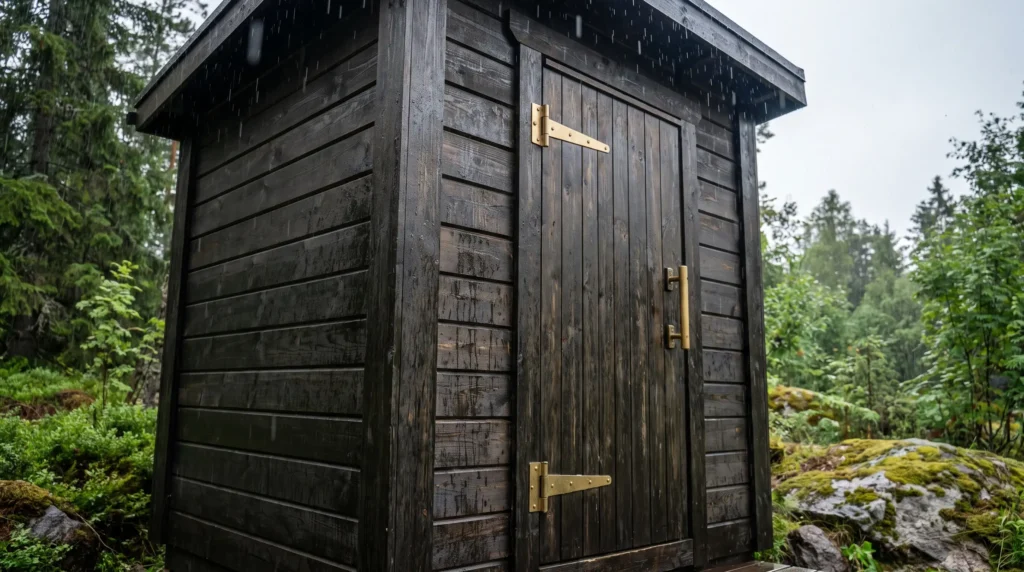
The places where water collects age fastest. Depending on the model, the roof is covered with bitumen shingles, torch-on bitumen or metal roofing. A cube profile with rounded edges leaves no places on the structure where water could stand or snow could lie.
The base must be firm and level – a concrete slab, paving or compacted gravel with timber bearers. Space should be left under the sauna for ventilation, so that the lower part of the structure dries out after rain. A sauna placed directly on damp ground ages from below, where it cannot be seen.
Heater, stones and interior
The heater is the functional core of a sauna and, at the same time, a replaceable part. Three questions verify its quality:
- Who is the manufacturer and what is the output? Our models use electric Harvia heaters with an output of 6 to 9 kW according to cabin volume; for wood-burning, for example, the Harvia M3 with an insulated flue.
- Does the output match the cabin volume? An undersized heater warms up slowly and never reaches a stable temperature. An oversized one places an unnecessary load on the supply.
- Does the heater comply with the relevant standard? Electric sauna heaters are assessed under EN 60335-2-53, wood-burning heaters under EN 15821. A reputable seller can tell you which standard the heater meets and provide the operating instructions.
For the long-term function of the heater and interior, Harvia recommends checking the stones at least once a year and replacing any that have crumbled. Crumbled stones restrict airflow around the heating elements, which reduces efficiency and can lead to overheating. Benches are treated with paraffin oil once or twice a year, and after washing the sauna is dried by heating it for at least 30 minutes. More on choosing stones is in the glossary entry sauna stones.
Electrical installation: no room for improvisation
Electrical installations in rooms and cabins containing sauna heaters are covered by the European harmonisation document HD 60364-7-703 (IEC 60364-7-703), which each country adopts in its own wiring rules – in the United Kingdom, for example, as Section 703 of BS 7671. When buying, check that the wiring in the cabin is heat-resistant, that the luminaire is rated for saunas and that the seller provides documentation for the electrician. The heater is always connected by a qualified electrician. Current EU requirements for CE marking are published by the European Commission (single-market-economy.ec.europa.eu).
Ventilation and moisture
A sauna is designed as a system, not as a timber hut with a heater. Ventilation with an air inlet near the floor and an outlet near the ceiling keeps the temperature even across the full height of the cabin and removes moisture from the timber after each session. For lifespan, this is decisive: without a ventilation design, moisture stays in the structure, the timber darkens and mould becomes a risk. Insulation therefore only works together with correctly designed ventilation.
Assembly, warranty and servicing
Construction quality only pays off if the sauna is installed correctly and servicing is in place. When comparing offers, ask who installs the sauna, what the warranty is and who handles a fault once it has expired. LUXURELAX saunas include delivery and free commissioning (connection to the mains, heater connection, testing and a handover of operation). Assembly of the structure costs €390 on models where the product page states it. The heater is configured and added by type. The warranty is 2 years, and our sauna servicing covers 4 years.
A care plan that extends sauna lifespan
| When | What to do |
|---|---|
| After every session | let the sauna air until the timber is dry; wipe the benches |
| When cleaning, once or twice a year | wash the benches with warm water and a soft brush, treat them with paraffin oil, dry the sauna by heating it |
| Once a year | check and restack the stones; check the roof, door and window seals; re-tighten the straps (where the model has them); make sure the space under the sauna is clear and dry |
| Spruce cladding: every 2–4 years (exposed elevations), after 5 or more years on sheltered sides | renew the wood stain when water stops beading on the surface; the interval is set by the coating manufacturer and the condition of the surface |
| Thermowood cladding: according to the condition of the surface | treat with a UV-filter oil so that the timber keeps its colour (not with a stain or paint) |
| In the event of a fault or doubt | a service visit |
Winter adds specific tasks – clearing snow from the roof and checking the ventilation. They are covered in the guide to operating a sauna in winter.
When a more robust construction pays off and when a simpler one is enough
Not every use calls for an insulated frame and thermowood.
- Occasional seasonal use in a sheltered spot: a solid spruce structure with regular coating is a proportionate choice – provided it has a stated wall thickness, a heater from an established manufacturer and a ventilation design.
- Year-round use several times a week: an insulated frame or thermowood – a shorter warm-up, lower consumption and less stress on the timber.
- An exposed location (north-facing, windy, close to water): thermowood or metal cladding with lower maintenance requirements.
- Holiday rental, guesthouse, wellness business: frequent heating and more users. Timber durability, heater sizing and available servicing matter more here than the purchase price.
- The seller cannot document the species, wall thickness, insulation and heater standard: a low price is not an advantage, but an unknown.
How the individual parameters translate into price is shown in the article how much does a sauna cost.
Technical verification checklist
Before deciding, ask the seller for:
- the exterior and interior timber species and their treatment,
- the wall thickness and the build-up of the structure,
- the type and thickness of insulation in the walls, roof and floor,
- the type of roofing and the requirements for the base,
- the heater manufacturer and output in kW relative to the cabin volume in m³, and the standard the heater meets,
- the ventilation design,
- documentation of the electrical installation and the supply requirements,
- care instructions, who carries out the assembly, the warranty terms and how servicing and spare parts are provided.
Next step
The parameters of each model – timber species, wall thickness, insulation and heater – are listed in the product description in the outdoor saunas category. We prepare the configuration on request, including the choice between spruce and thermowood – send us your requirements via the contact form. How delivery and assembly work is described in the article how to build a sauna.
You may also be interested in
- How much does a sauna cost in 2026: what determines the price and what is included
- Outdoor sauna in winter: operation and energy use
- Sauna heater vs infrared cabin
Sources
- EN 350: Durability of wood and wood-based products – natural durability classes (spruce 4, pine and larch 3–4): Swedish Wood, Durability and resistance, https://www.swedishwood.com/wood-facts/about-wood/from-log-to-plank/durability-and-resistance/
- Thermowood, durability class 2–3 under EN 350 depending on the degree of heat treatment: Lunawood, Thermowood Fact Sheet, https://lunawood.com/wp-content/uploads/2019/04/Lunawood_Thermowood_Fact_Sheet.pdf
- Coating interval for timber cladding – exposed elevations 2–4 years, sheltered 5 years or more: Abodo, How often do I need to stain timber cladding, https://www.abodowood.co.uk/resources/articles/how-often-do-i-need-to-stain-timber-cladding
- Harvia: The easy guide to looking after your sauna stones – check the stones at least once a year, https://www.harvia.com/en-US/ideas-and-trends/products/the-easy-guide-to-looking-after-your-sauna-stones/
- Harvia: 5 sauna maintenance tips – paraffin oil on benches once or twice a year, drying by heating for at least 30 minutes, https://www.harvia.com/en/ideas-and-trends/inspiration/5-sauna-maintenance-tips/
- EN 60335-2-53: Safety of household electrical appliances – particular requirements for sauna heating appliances and infrared cabins: https://standards.iteh.ai/catalog/standards/clc/3e700d65-3081-4aba-ae78-c4f4e84c854b/en-60335-2-53-2011
- EN 15821: Wood-log fired sauna heaters – requirements and test methods: https://www.standardsuk.com/products/BS-EN-15821-2010
- HD 60364-7-703 / IEC 60364-7-703: Low-voltage electrical installations – requirements for special installations or locations – rooms and cabins containing sauna heaters (adopted nationally, e.g. BS 7671 Section 703 in the UK)