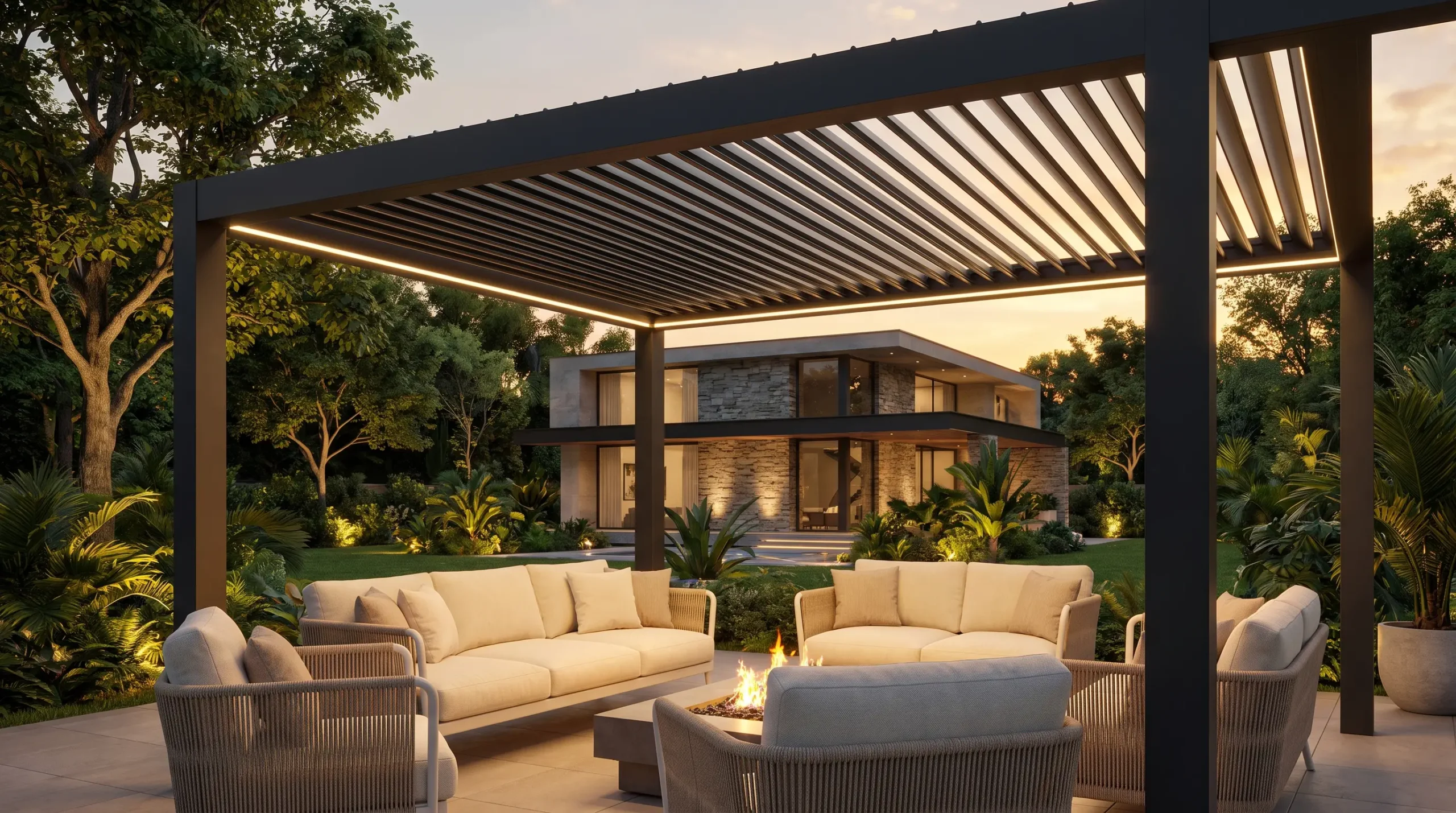
Pergola vs garden shed: both structures cover part of the garden, but they do a different job. A pergola is an open structure with a roof, a space for spending time outdoors protected from rain and sun. A garden shed is an enclosed building with walls and a door, a space for storage, a workshop or a hobby. If your question is where to sit, eat or keep a sauna or hot tub under a roof, choose a pergola. If your question is where to store tools, bicycles and garden furniture, choose a shed. On a larger plot, the two complement each other.

Pergola vs garden shed compared
| Parameter | Pergola | Garden shed |
|---|---|---|
| Purpose | spending time outdoors under a roof | storage, workshop, hobby space |
| Construction | load-bearing posts and a roof, open sides | walls, roof, door, often a floor |
| Protection | from rain and sun; sides optionally with glazing or shading | from the weather and from unauthorised access (lockable) |
| Light and air | natural light and airflow | limited, depending on windows |
| Connection to the house | anchored to the facade or free-standing | usually free-standing |
| Installation | Axis Line and Axis Louver: professional installation or self-assembly with delivery of the complete structure | depending on the manufacturer, often self-built |
| Maintenance | powder-coated aluminium needs no coatings; wooden pergola: re-coating roughly every 2–4 years for exposed timber | a timber shed needs regular coating, a metal shed needs checking for corrosion |
| Expansion | modular: glazing, shading, LED, a further module | limited |
| Base price in the LUXURELAX e-shop | Axis Line from €2,149, Axis Louver from €5,849 | LUXURELAX does not sell sheds |
Pergola prices are “from” prices including VAT as listed in the e-shop on 28 September 2026. The final price depends on dimensions, roofing and accessories.

When a covered outdoor living space makes sense
You want to extend the house into the garden. A pergola anchored to the facade connects to the living area and creates a covered space that can be used even when it rains. A garden shed cannot fulfil this function, as it is an enclosed room away from the house.
You are looking for a place to dine and sit. A fixed roof of polycarbonate or glass protects against rain; a louvred roof lets you regulate sun and ventilation. The open sides keep the connection with the garden.
You want to cover a sauna or a hot tub. A pergola creates a stable environment for a wellness area: it protects against rain and snow while allowing the space to ventilate. With a sauna or tub heated by a wood-fired heater, however, the flue and safe distances from the roof must be resolved according to the heater manufacturer’s instructions and fire safety regulations. Under a roof, an electric heater is more practical. The choice between a sauna and a hot tub is discussed in the article sauna or hot tub; models are listed in the outdoor saunas and hot tubs categories.
You want to use the space outside the summer months too. A pergola can be fitted with framed or frameless glazing, and the Axis Louver also with screen blinds. This closes the space against wind without creating a full building with walls.
When a garden shed makes sense
- You need a lockable, dry space for tools, a lawnmower, bicycles or garden furniture.
- You want a workshop or hobby room with its own electrical connection.
- You store items that are sensitive to moisture and dust.
- You already have space for outdoor living, such as a terrace under a roof overhang or an existing canopy.
A tool shed does not replace a covered terrace, and a pergola does not replace storage space. A garden shed with a porch or a small canopy addresses both, but this is usually a small covered entrance in front of the shed, not a full seating area.
Pergola vs gazebo vs garden shed: the difference in terms
- Pergola: a roofed structure on posts, anchored to the house or free-standing, with sides that are open or fitted with glazing or shading.
- Gazebo: traditionally a free-standing roofed structure in the garden, often made of timber, with open or partly enclosed sides. A modern or year-round aluminium gazebo with glazing comes close to a pergola in function.
- Garden shed: an enclosed building with walls and a door, intended for storage or work.
The decision therefore does not depend on the name, but on whether you need an open space for people or an enclosed space for things.

Fixed roof or rotating louvres
If a pergola is the answer, the next decision concerns the roof. LUXURELAX supplies only aluminium pergolas, not wooden ones. Two types are available:
- Axis Line: fixed roof. Roofing of 16 mm multiwall polycarbonate with UV protection or 44.2 laminated safety glass, or insulated double glazing. Depth up to 6,000 mm, width from 1,000 mm. No louvres and no motorised control: simple, permanent protection from rain.
- Axis Louver: bioclimatic roof. Aluminium louvres rotating through 130° regulate light and ventilation and, in the closed position, protect against precipitation. A SOMFY drive controls the louvres, LED lighting and screen blinds. Module up to 6,000 × 4,000 mm; larger areas by joining modules.
Both structures have a declared roof load of 110 kg/m², wind resistance of up to 100 km/h and integrated water drainage in the profiles. The surface is protected by powder coating, with no need for regular re-coating. A wooden pergola is an alternative offered by other suppliers on the market. Its coating is renewed roughly every 2–4 years on exposed timber, and after 5 years or more on sheltered sides. A comparison of both materials is in the article aluminium or wooden pergola. Both pergolas are listed in the aluminium pergolas category.
Pergola vs garden shed: a decision guide
| If… | Choose… |
|---|---|
| You want covered seating or dining next to the house | a pergola anchored to the facade |
| You need to store tools, bicycles or a lawnmower | a garden shed |
| You want to cover a sauna or a tub | a pergola; with a wood-fired heater, only with a properly resolved flue |
| You want to regulate sun and ventilation through the roof | a pergola with louvres: Axis Louver |
| You want a simple, permanent roof against rain | a pergola with a fixed roof: Axis Line |
| You need a workshop with electricity and a lock | a garden shed |
| You have room for both | a pergola by the house and a shed at the back of the plot |
Location and permission
A pergola and a garden shed are both structures that may be subject to building regulations. Building rules depend on your country and municipality. Whether your structure requires notification, permission or another procedure depends on its dimensions, height, position on the plot and whether the pergola is attached to the house. Check the conditions with the local building authority before ordering.
For a pergola anchored to the house, the condition of the facade and of the anchoring substrate also matters. For a free-standing pergola, the foundations are decisive. Installation and subsequent servicing of the aluminium pergolas are provided by LUXURELAX; the scope is described on the pergola service page.
Next step
Dimensions, roofing, colours and accessories for both pergolas are listed on the Axis Line and Axis Louver product pages. We prepare the configuration on request via the contact page.
You may also be interested in
- Aluminium or wooden pergola: maintenance and service life compared
- Sauna or hot tub: what to choose first
- The outdoor sauna in winter
Sources
- Abodo: How often do I need to stain timber cladding: exposed timber 2–4 years, sheltered 5 years or more
- efarby.sk: Drevo – exteriér / odpovede špecialistu (Wood for exterior use: specialist answers, in Slovak): standard coatings on the sunny side after approximately 3 years, quality systems 6 years or more