Traditional Sauna or Infrared Cabin: Differences in Heating, Consumption and Research
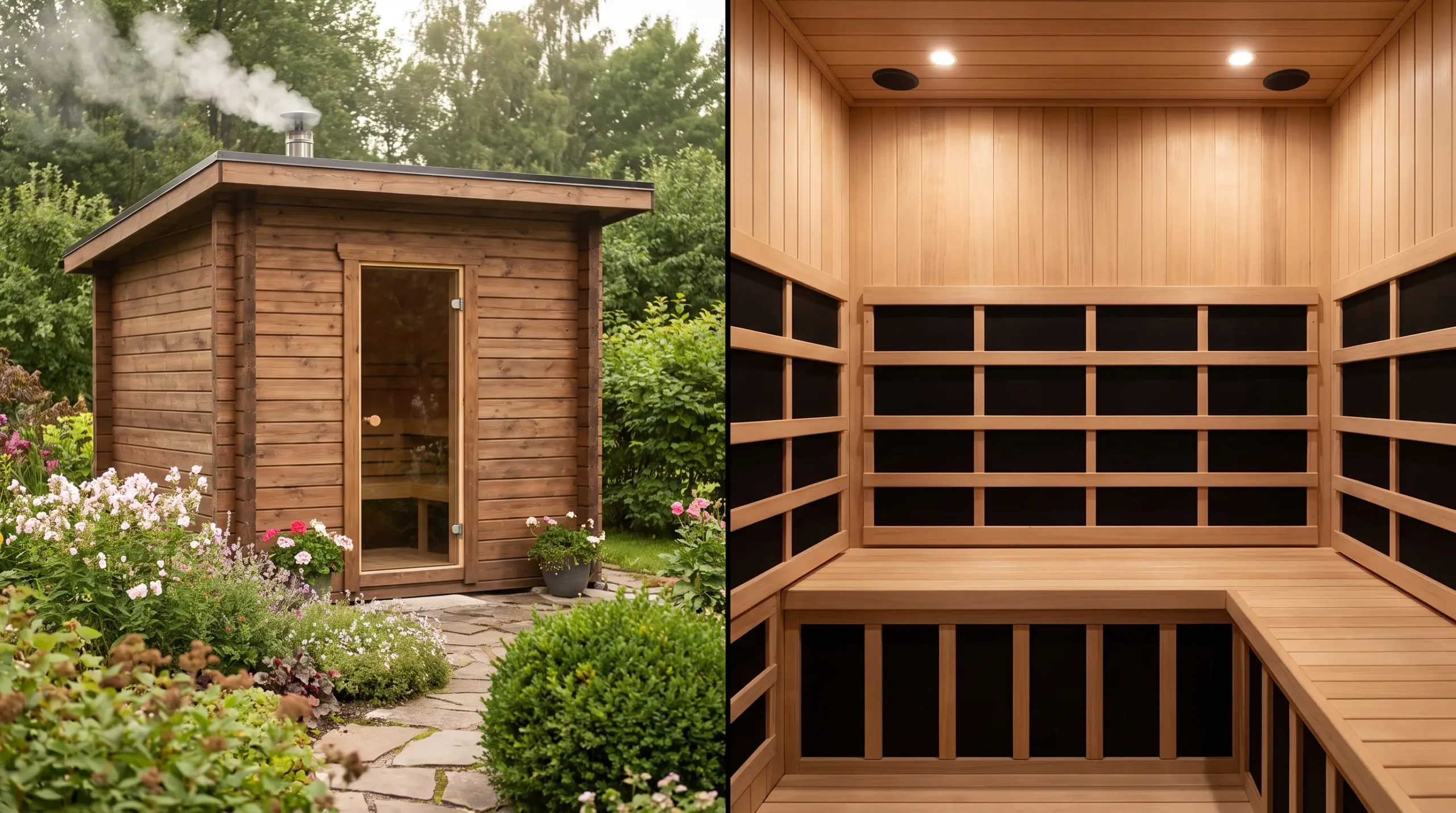
When choosing between a traditional sauna with a heater and an infrared cabin, four things decide: the heating method, temperature, consumption and location. A traditional sauna heats the air and stones to 80–100 °C and works with a cycle of heating and cooling. An infrared cabin heats the body directly with emitters at a lower air temperature, typically up to 45–60 °C. A cabin with emitters is better suited to a flat, to people who tolerate hot air poorly, and to a low power requirement. A sauna with a heater is better suited to regular use by several people, to a garden setting, and to those who want the method with the longest research record.
LUXURELAX does not sell infrared cabins. The comparison is based on manufacturer data and the studies listed at the end of the article.
Traditional sauna or infrared cabin at a glance
| Parameter | Infrared cabin (indoor) | Traditional sauna with a heater (Finnish type) |
|---|---|---|
| Heating method | infrared emitters heat the body directly, the air only partly | the heater warms the air and stones; heat also radiates from the walls |
| Air temperature | lower, typical models max. 45–60 °C | 80–100 °C |
| Humidity | low, no water on stones | low, briefly higher after water is poured on the stones |
| Power (examples) | 1,440 W (1 person), 1,750 W (2 persons) | Harvia 6 kW (2 persons), Harvia 9 kW (2–4 persons), larger according to volume |
| Connection | 230 V according to manufacturer data | 380 V, Harvia Vega heaters also 230 V; dedicated supply and electrical inspection |
| Consumption per session | at most 1.75 kWh (1,750 W × 1 hour) | model calculation from the calculator: 12.4 kWh (9 kW, 45 min heating, 75 min use) |
| Location | mainly indoors, outdoor models exist | indoors and in the garden, outdoor models for year-round use |
| Capacity | market examples for 1 and 2 persons, larger models exist | LUXURELAX range: 2–8 persons |
| Cooling cycle | not part of the method | alternating heat and cooling is part of the method |
| Research | fewer studies, preliminary results | decades of observational data and studies with athletes |
| Base price | depends on the manufacturer and cabin size | from €3,329 (indoor Nordic Room) and from €3,612 (outdoor Nordic Pod), excluding the heater (added according to type) and assembly (€390), as of 26 September 2026 |

The main difference: heating the air or radiating onto the body
Infrared heat warms the body directly, without first heating the air around you (Mayo Clinic, 2024). The emitters are placed in the walls and often near the feet as well. You feel the heat mainly on the side of the body facing the emitters. The air temperature stays lower, so a session is more tolerable for people who do not cope well with hot air.
A traditional sauna works the other way round. The sauna heater warms the air and the sauna stones, and the timber walls store the heat and release it back. When water is poured on the stones, humidity rises briefly and with it the perceived temperature. The body warms evenly from all sides, and a cool-down follows. This cycle is repeated two to three times.
Infrared cabin: who it suits, advantages and limits
Who it suits: a flat or house without a garden, an individual or a couple, people who tolerate 80–100 °C poorly, and those who want a simple installation.
Advantages:
- low power requirement, 1.4–1.8 kW for cabins for 1–2 persons according to manufacturer data,
- connection to 230 V and a small footprint, for example 120 × 89 cm for a 2-person cabin according to manufacturer data,
- a lower air temperature, which many people tolerate better than 80–100 °C,
- short preparation, because there is no large mass of air and timber to heat.
Limits:
- there is no steam and no classic cycle of heating and cooling,
- the heat acts mainly on the sides of the body facing the emitters,
- typical models are designed for indoor use,
- research is still limited and the results are preliminary.

Sauna with a heater: who it suits, advantages and limits
Who it suits: households with a garden or a suitable room, families, holiday rentals, guesthouses and wellness facilities, athletes, and people who want to use the sauna regularly several times a week.
Advantages:
- a full heat cycle with cooling, which most sauna studies have examined,
- capacity for several people at once,
- outdoor models with PAROC 10 cm insulation hold a stable temperature all year round,
- a choice between an electric Harvia heater and a wood-fired heater.
Limits:
- a higher power requirement and a dedicated electrical supply,
- longer heating and higher consumption per session,
- greater space requirements,
- with some heart conditions, high temperatures are unsuitable and sauna use should be discussed with a doctor.
How much electricity a sauna heater and an emitter cabin use
A simple formula is enough for the comparison: consumption = power × time. The electricity price of €0.22 per kWh used below is the model assumption of our calculator; your own tariff may differ.
- Infrared cabin, 1,750 W: even if the emitters ran at full power for a whole hour, including warm-up, consumption would be at most 1.75 kWh. At €0.22 per kWh, that is approximately €0.39.
- Sauna with a 9 kW Harvia heater: the sauna running costs calculator assumes full power during heating and approximately half power during use. A model calculation with 45 minutes of heating and 75 minutes in the sauna gives 12.4 kWh, or approximately €2.72.
With two sessions a week, this amounts to at most approximately 15 kWh (€3.30) a month for the infrared cabin and approximately 107 kWh (€23.60) for the sauna with a 9 kW heater. The difference is roughly sevenfold. In winter, an outdoor sauna uses more; details are covered in the article the sauna in winter. A sauna with a heater, however, is usually used by more people at once, so the figure per person is more favourable.
What research says about the traditional sauna and infrared heat
Traditional sauna. The largest study followed 2,315 Finnish men for almost 21 years on average. Those who used the sauna 4–7 times a week, compared with those who used it once a week, had a 50% lower risk of death from cardiovascular disease and a 40% lower risk of death from any cause (Laukkanen et al., 2015). This is an observational study: it shows an association, not a cause. In endurance runners, a series of post-training sauna sessions increased blood plasma volume by 7.1% (Scoon et al., 2007).
Infrared cabin. Mayo Clinic states that infrared cabins have been studied in conditions such as high blood pressure, heart failure and arthritis. Larger and more rigorous studies are, however, needed to confirm the results. According to the same source, no adverse effects have been reported (Mayo Clinic, 2024). In a study with physically active men, a 30-minute session in a cabin with infrared emitters at 35–50 °C after endurance training led to faster recovery of explosive performance. Heart rate afterwards was lower than after a classic sauna with higher humidity (Mero et al., 2015).
Conclusion for your choice: if you want the method with the longest research history, it is the traditional sauna with a heater. If you need a gentler heat load, an infrared cabin is a reasonable alternative. More on the sauna and sport is in the article sauna and muscle recovery after sport.

Decision guide
- You have neither a garden nor a suitable room for a cabin with a heater → infrared cabin.
- You tolerate hot air poorly or have a health restriction → consult a doctor; a cabin with a lower air temperature is often more suitable.
- You want to use the sauna with family or guests → a sauna with a heater for 4–8 persons.
- You want a sauna in the garden with cooling in the open air → outdoor and garden saunas.
- You have a room in the house and want a classic sauna → indoor saunas, for example the Nordic Room for 2 persons. A 6 kW Harvia heater is selected for it in the configuration (it is not included in the sauna price); the Vega model can also be connected to 230 V.
- The lowest electricity consumption is decisive → infrared cabin.
- Regular heat as part of recovery is decisive → sauna with a heater.
Installation and space
An infrared cabin, according to manufacturer data, connects to a 230 V supply and fits into a bedroom, bathroom or loft. When buying, check whether the model is designed for indoor use only or for outdoor use as well.
A sauna with a heater needs a supply that matches the heater. A classic sauna in a flat or house also needs a suitable room and ventilation (see saunas for indoor installation). Harvia Top Steel heaters run on 380 V, Harvia Vega heaters on 230 or 380 V. Connection and inspection must be carried out by a qualified electrician in line with local regulations. Outdoor models are placed on a level, firm base. The structural base, wall thickness and insulation determine temperature stability and service life. More in the article sauna construction quality.
Next step: Technical parameters of the models are listed in the Finnish saunas category. We prepare the configuration with a specific heater and its power requirement on request via the contact page.
You may also be interested in
- Sauna or hot tub: what to choose first
- The sauna in winter: operation and electricity consumption
- Sauna and muscle recovery after sport
Sources
- Mayo Clinic Staff. Do infrared saunas have any health benefits? Mayo Clinic, updated 13 September 2024. https://www.mayoclinic.org/healthy-lifestyle/consumer-health/expert-answers/infrared-sauna/faq-20057954
- Mero A, Tornberg J, Mäntykoski M, Puurtinen R. Effects of far-infrared sauna bathing on recovery from strength and endurance training sessions in men. SpringerPlus. 2015;4:321. doi:10.1186/s40064-015-1093-5
- Laukkanen T, Khan H, Zaccardi F, Laukkanen JA. Association between sauna bathing and fatal cardiovascular and all-cause mortality events. JAMA Intern Med. 2015;175(4):542–548. doi:10.1001/jamainternmed.2014.8187
- Scoon GSM, Hopkins WG, Mayhew S, Cotter JD. Effect of post-exercise sauna bathing on the endurance performance of competitive male runners. J Sci Med Sport. 2007;10(4):259–262. doi:10.1016/j.jsams.2006.06.009
- Kukkonen-Harjula K, Oja P, Laustiola K, et al. Haemodynamic and hormonal responses to heat exposure in a Finnish sauna bath. Eur J Appl Physiol Occup Physiol. 1989;58:543–550. doi:10.1007/BF02330710
- Technical data of commonly sold infrared cabins for 1 and 2 persons (power 1,440 W and 1,750 W, 220–240 V, max. temperature 45–55 °C and 45–60 °C), manufacturer data, verified 26 September 2026.
- LUXURELAX product pages and calculator (Harvia heaters, PAROC insulation, base prices), verified 26 September 2026.
Note: This article is for information only and does not replace consultation with a doctor. If you have heart or vascular disease or high blood pressure, are pregnant or take medication, consult a doctor before using a sauna.