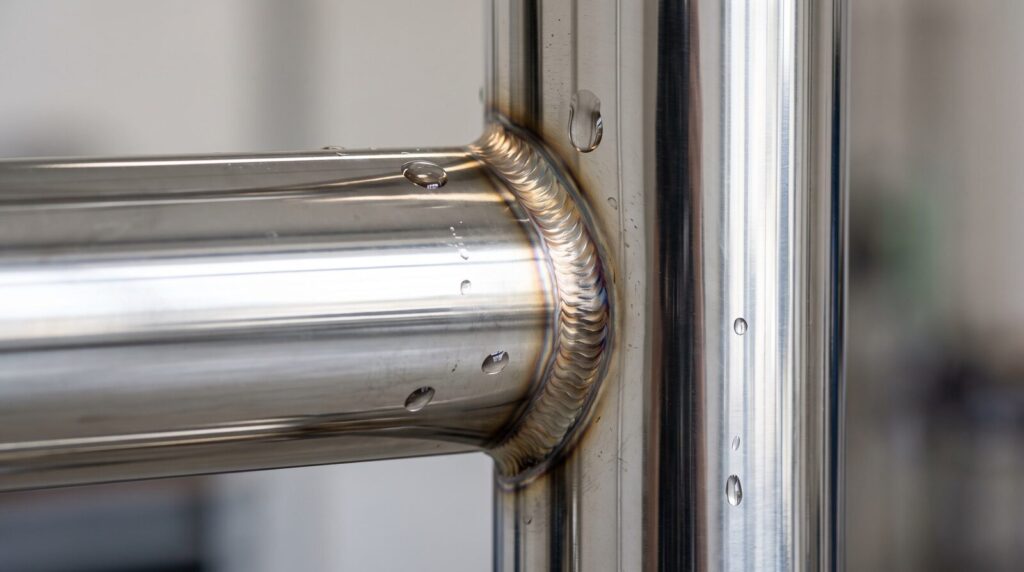
AISI 304 is an austenitic stainless steel containing roughly 18% chromium and 8% nickel, and it is among the most widely used stainless grades in manufacturing. The chromium forms a thin passive oxide layer on the surface that protects the material from oxidation and re-forms by itself after scratching. In wellness construction, AISI 304 is used for parts that are not in permanent contact with chemically treated water – structural brackets, frames, steel bands around wooden tubs, steps, handrails and fixings. Unlike AISI 316 it contains no molybdenum, so its resistance to chlorides is lower. In an environment free of chlorine and salt, however, it offers comparable service life at a lower cost.
The difference between the two grades is molybdenum. Without it, AISI 304 is more sensitive to pitting corrosion, which is triggered by chlorides from chlorinated or salt water. The decision therefore does not rest on which steel is more resistant, but on what the part will actually be exposed to.
| Environment | Suitable grade | Why |
|---|---|---|
| Structure away from water, dry exterior | AISI 304 | Ordinary atmospheric corrosion is manageable for 304 |
| Occasional contact, splashing water | AISI 304 | Short-term wetting without chloride build-up |
| Permanent contact with chlorinated water | AISI 316 | Molybdenum protects against chloride pitting |
| Salt water and salt aerosols | AISI 316 | High chloride concentration attacks 304 |
| Space above the hot tub water line, steam | AISI 316 | Condensate carries chemicals to parts above the water too |



We're happy to help personally. Leave us your contact, or write or call us:
+421 940 916 815 info@luxurelax.sk