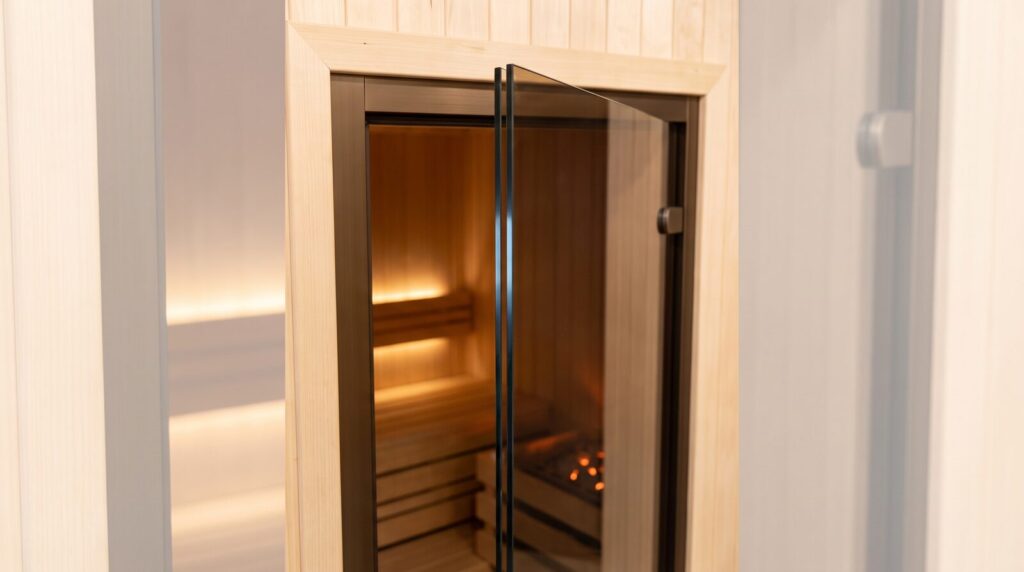
Tempered safety glass is a type of glass that has undergone a special heat treatment process involving high-temperature tempering followed by rapid cooling. This process alters the internal stress of the material and significantly increases its mechanical strength and resistance to temperature changes. Compared to ordinary glass, toughened glass is 4–5 times stronger and is capable of withstanding high thermal and mechanical stress. If broken, it does not shatter into sharp, dangerous shards, but into small, blunt fragments, which minimises the risk of injury. In wellness applications, it is used for sauna doors, fixed glass walls, pergolas or protective panels. Thicknesses of 8 mm and 10 mm are the standard for safe and long-term stable use.
The thickness of safety glass is not chosen by appearance but by the size of the pane and the way it is fixed. A larger area means greater deflection under load, which is compensated for by thickness.
| 8 mm | 10 mm | |
|---|---|---|
| Typical use | Sauna doors, smaller fixed panels | Larger glazed walls, pergola glazing |
| Maximum pane area | Smaller | Larger |
| Weight per m² | Lower | Higher |
| Demands on fittings and hinges | Lower | Higher |
| Stiffness under wind load | Lower | Higher |
Once it has been toughened, tempered glass can no longer be cut, drilled or ground – every opening for hinges, a handle or a magnetic catch has to be in the pane before tempering. Changing the fittings after manufacture therefore means a new pane, not an alteration to the existing one. The edge treatment and any sandblasting or printing are likewise specified in advance.



We're happy to help personally. Leave us your contact, or write or call us:
+421 940 916 815 info@luxurelax.sk