Materials and technologies

Chiller (Active Water Cooling)

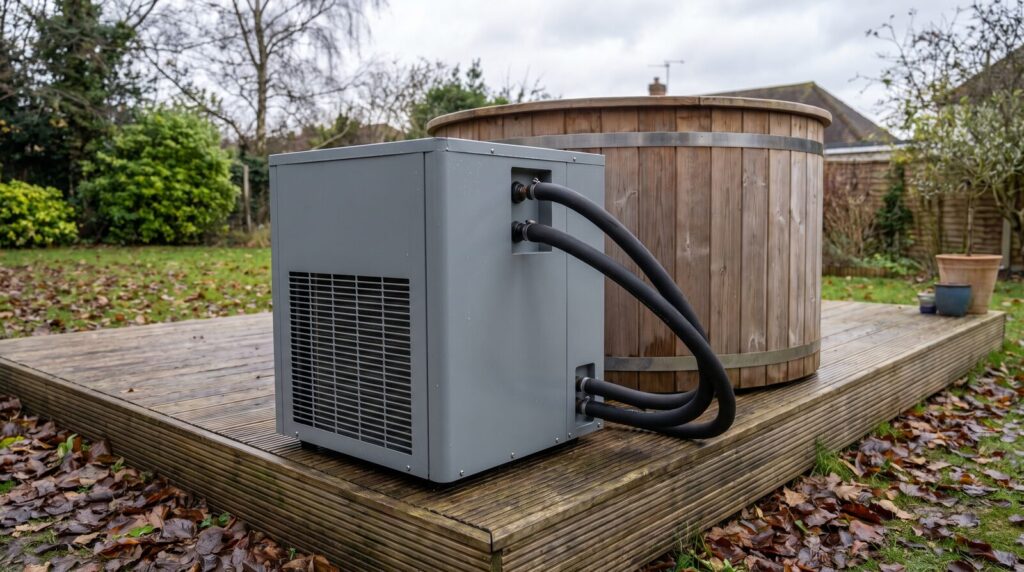
Chiller for active water cooling beside a wooden cooling tub

A chiller is a device designed for active water cooling using a compressor-based refrigeration circuit, similar in principle to a heat pump or air conditioning unit. In a wellness context, it is used for cooling tubs, cold plunge pools or combined hot and cold systems. Water circulates through a heat exchanger (often titanium, for its corrosion resistance), where heat is transferred to the refrigerant. The system allows precise setting of the target temperature, typically within a range of 3–15 °C. Unlike passive cooling (ice, well water), a chiller provides a stable and controlled solution. Unit capacity is sized according to water volume, thermal load and frequency of use.


Advantages of active water cooling

  • Stable and precise water temperature: No need to top up ice or wait for natural cooling. Temperature is controlled digitally to within a degree.
  • Year-round cold-water immersion: Independence from outdoor conditions allows cold plunge use even in summer, when ambient temperature is high.
  • Higher hygiene standard: Circulation through the heat exchanger supports filtration and can be integrated with a UV or ozone system.
  • Comfort and time savings: No manual handling of ice or water changes. The system operates automatically according to its settings.

What decides the chiller output you need

Chiller output is not set by the number of people but by how much heat it has to remove from the system. Several factors enter the calculation at once, and the specific sizing is a matter for the equipment supplier.

  • Water volume: a larger volume takes longer to cool but holds its temperature more steadily.
  • Target temperature: the difference between 12 °C and 4 °C means markedly different demands on output.
  • Ambient temperature and sun exposure: a tub in direct sun takes in heat from its surroundings all day long.
  • Insulation and cover: an insulated shell and a thermal cover reduce heat gains, and therefore the output needed as well.
  • Frequency of use: every entry into the water brings heat that has to be removed again.

Chiller and heat pump: the same technology, the opposite direction

Both a chiller and a heat pump work with a compressor circuit. The difference lies in the goal: a chiller takes heat out of the water and gives it up to the surroundings, whereas a heat pump takes heat from the surrounding air and gives it to the water. Some units handle both modes, so in a sauna-and-tub setup they can heat in winter and cool in summer.


Frequently Asked Questions

The principle is similar, but a chiller is optimised for cooling water rather than heating a space. Some models are reversible, providing both cooling and heating.

It depends on the water volume and target temperature. Small cooling tubs (300–800 l) typically use units with approximately 1–3 kW of cooling capacity.

Consumption depends on the tub's insulation and the difference between target and ambient temperature. A well-insulated system operates relatively efficiently.

It contains a compressor and a fan, so it produces noise similar to an air conditioning unit. Quality units have noise levels optimised for residential use.

Yes. Inspection of the refrigeration circuit, filter cleaning and heat exchanger checks are recommended at least once a year.

Yes, in dual systems (hot and cold contrast systems) it can form part of a single technical unit, though it requires separate control.

If the goal is regular cold-water immersion, it is a functional element, not a design accessory. Without active cooling, stable temperature control during warm periods is practically unattainable.
Where to find it
Online configurator

Modular system
Precise configuration

Each model is based on a structurally proven foundation.
Configuration takes place within defined variants that maintain stability, safety and material integrity.

The result is a solution that naturally fits into the space and supports long-term regeneration.
50 000+
combinations