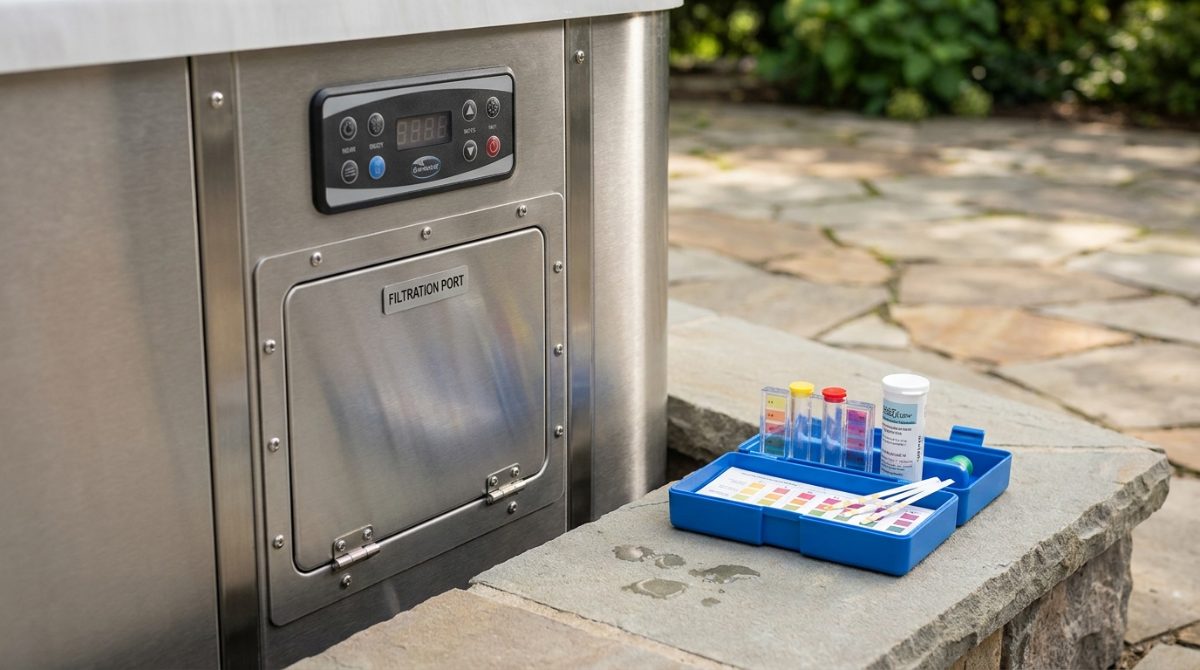
Hot tub maintenance rests on one principle: the chemicals keep the water within the range in which it is hygienically safe. According to the CDC, this means a pH of 7.2–7.8 and free chlorine of at least 3 mg/l, or bromine at 4–8 mg/l. In practice, it comes down to three regular tasks: testing and adjusting the water, cleaning the filter and planned water changes. The weekly routine takes a few minutes.
The procedure in brief
- Test the pH and the sanitiser level.
- Adjust the pH first, then the sanitiser.
- Maintain sanitation with chlorine, bromine or a salt chlorinator.
- Rinse the filter and clean it chemically from time to time.
- Clean the waterline and the surfaces.
- Change the water according to the number of bathers.
- Schedule a service once a year. Drain the tub for the winter. Leave water in it during frost only if electric heating keeps it warm.
The exact dosage of products is always determined by the chemical manufacturer’s label and the tub’s manual. This procedure does not replace them.
What you will need
- test strips or a digital tester for pH, free chlorine or bromine, and alkalinity,
- pH minus and pH plus,
- a sanitiser (chlorine or bromine) or a salt chlorinator,
- a non-chlorine shock (oxidiser),
- a filter cleaner and a spare cartridge if you have a cartridge filter,
- a soft sponge, gloves and safety glasses.
Tubs with and without filtration
The procedure in this guide applies to tubs with water circulation, filtration and sanitation. With LUXURELAX tubs, filtration is part of the configuration – for example, the Nordic Halo model can be fitted with sand filtration, hydromassage and an electronic temperature controller.
A tub without filtration and sanitation works differently. The water cannot be kept in it over the long term, so it is drained after a certain number of baths and the tub is cleaned. The interval is set by the tub’s manual.
Hot tub maintenance plan: week, month, year
| Frequency | Task | Why |
|---|---|---|
| Before bathing and at least once a week | testing the pH and sanitiser level | the water changes with every bath |
| Weekly | adjusting the pH and sanitiser, rinsing the filter cartridge, removing debris from the surface | stable parameters, fewer chemicals |
| After heavy use | shock treatment | breaking down organic contaminants |
| Monthly | chemical cleaning of the filter, cleaning the waterline, checking the water level | biofilm and a clogged filter degrade the water |
| According to the formula (often quarterly) | changing the water, scrubbing the surfaces | chemicals can no longer remove accumulated substances |
| According to the filter manufacturer | replacing the cartridge or filter medium | a worn medium stops trapping contaminants |
| Annually | service inspection, seals, cover | reliable operation and service life |
| Before winter | draining and winterising; always drain a tub with a wood-fired heater during frost | water in the pipework and heater must not freeze |
Step 1: Test the water
Procedure. Dip a test strip into the water or take a sample for the tester. Measure the pH, free chlorine or bromine, and alkalinity.
Why. Sanitation is effective only at the correct pH. At pH 7.5, only half of the free chlorine is present as hypochlorous acid, which is roughly one hundred times more effective than the hypochlorite ion (MAHC). The higher the pH, the less effective chlorine there is.
What to watch out for. Do not test immediately after adding chemicals. Allow the circulation to mix the water as instructed on the product.
| Parameter | Target value | Source |
|---|---|---|
| pH | 7.2–7.8 | CDC, MAHC |
| Free chlorine | at least 3 mg/l (3–10 mg/l for public hot tubs) | CDC |
| Bromine | 4–8 mg/l | CDC |
| Alkalinity, water hardness | according to the chemical manufacturer’s instructions | chemical manufacturer’s instructions |
For comparison: for public hot tubs, the CDC recommends testing the water at least twice a day, and every hour during heavy use. For a private tub, testing before bathing and regularly once a week is sufficient.
Step 2: Adjust the pH first
Procedure. If the pH is low, add pH plus (sodium carbonate). If it is high, add pH minus (sodium bisulphate). Alkalinity is raised with sodium bicarbonate.
Why. The pH affects both the effectiveness of sanitation and irritation of the skin and eyes. Adjusting the sanitiser while the pH is wrong wastes chemicals.
What to watch out for. Add products while the circulation is running, one at a time. Test again after mixing and only then dose the sanitiser.
Step 3: Maintain sanitation
Procedure. Dose chlorine or bromine so that the value stays within the range in the table. After heavy use or if the water turns cloudy, use a non-chlorine shock.
Why. Warm water accelerates bacterial growth. The CDC states that hot tubs operate within the temperature range most favourable to Legionella bacteria (25–45 °C), and with inadequate sanitation Pseudomonas aeruginosa, which causes inflammation of the hair follicles, can multiply in them.
What to watch out for. Do not pour granules into one spot. Dissolve them as instructed and add them to the circulating water so that they do not concentrate on the surface of the liner.
A hot tub with a salt chlorinator
A salt chlorinator produces chlorine directly in the water by electrolysis of dissolved salt. The water contains fewer added chemicals, but in terms of sanitation it is still chlorine. The same target values for free chlorine and pH therefore apply, and testing is just as necessary. A salt chlorinator does not adjust the pH or replace filter cleaning. The salt concentration and electrode maintenance are specified by the chlorinator manufacturer.
Ozone generator and UV-C as a supplement
An ozone generator oxidises organic contaminants, and UV-C sterilisation inactivates microorganisms as the water passes through the chamber. Both technologies reduce the consumption of chlorine or bromine. They do not replace it completely, because they leave no lasting sanitising effect in the water.
Step 4: Clean the hot tub filter
Procedure. Depending on the type of filter:
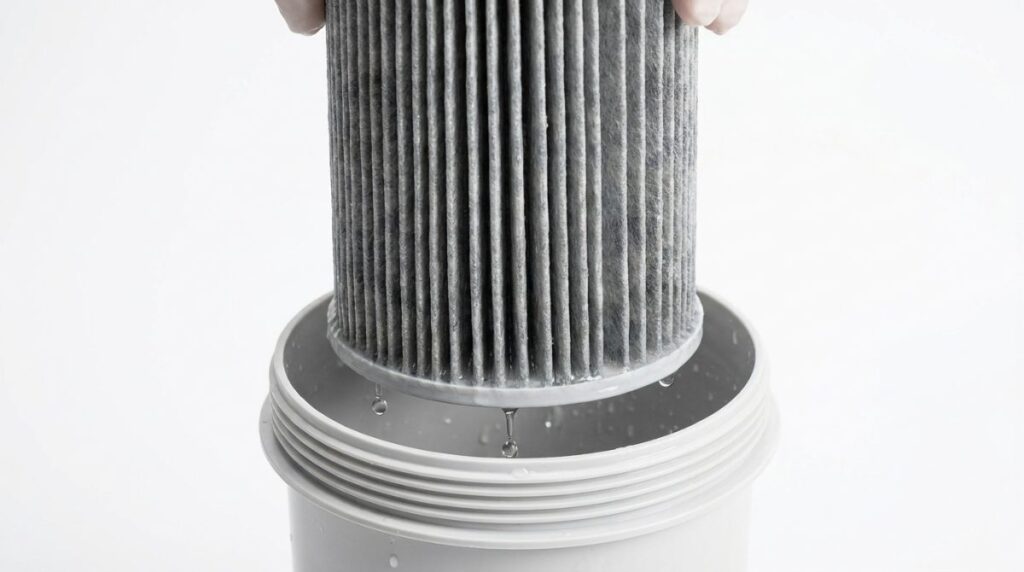
- Cartridge filter: once a week, rinse it with a jet of water between the pleats, without soap or detergents. Once a month, soak it in filter cleaner as instructed and rinse it thoroughly before refitting.
- Sand filtration: regular backwashing as instructed for the filter (CDC).
- Filter balls: used instead of sand; they trap particles from approximately 3 microns and can be washed and reused.
Why. A clogged filter lets contaminants through and increases resistance, which puts strain on the pump.
What to watch out for. Cleaner residue on the cartridge causes foaming. Replace the cartridge as specified by the filter manufacturer, or sooner if the pleats are damaged, it is disintegrating or it does not return to its original colour after cleaning.
Step 5: Clean the waterline and surfaces
Procedure. Once a month, clean the band at water level with a soft sponge and a product designed for hot tubs. Scrub all surfaces every time the tub is drained.
Why. Oils, creams and sweat settle at the waterline. Biofilm forms there, in which bacteria are protected from the sanitiser. The CDC recommends scrubbing all surfaces thoroughly every time a hot tub is drained.
What to watch out for. An acrylic liner is non-porous and easy to clean. Do not use rough sponges or abrasive products.
Step 6: Change the water
Procedure. You can calculate the water change interval using the formula the CDC gives for hot tubs:
number of days = water volume in litres ÷ 11.4 ÷ average number of bathers per day
Example: 1,500 litres and an average of 2 people a day → 1,500 ÷ 11.4 ÷ 2 ≈ 66 days, roughly once every two months. With 4 people a day, it is about once a month.
Why. Every bath adds dissolved substances that chemicals cannot remove. The water then responds to dosing less and less well.
What to watch out for. Change the water sooner if persistent foam, cloudiness or a chemical odour appears despite correct values. When draining, scrub the surfaces and clean the filter.
The CDC formula is intended for public hot tubs. For a private tub, it is a sensible starting point, not a binding standard.
Step 7: Annual service and winterising
Procedure. Once a year, have the pumps, heater, seals and control unit inspected. For tubs with Balboa controls, the sensors and error messages are also checked. For the winter, drain and winterise the tub as described in the article hot tub in winter. You can leave water in the tub during frost only if you keep it warm, and this makes sense only with electric heating. A tub with a wood-fired heater is always drained during frost, even between baths.
Why. A service inspection reveals worn parts before they cause a fault. Frozen water in the pipework, pump or heater can damage components.
What to watch out for. Also check the thermal cover. It protects the water from debris and limits heat loss.
Hot tub chemicals: an overview of products
| Product | Purpose | When |
|---|---|---|
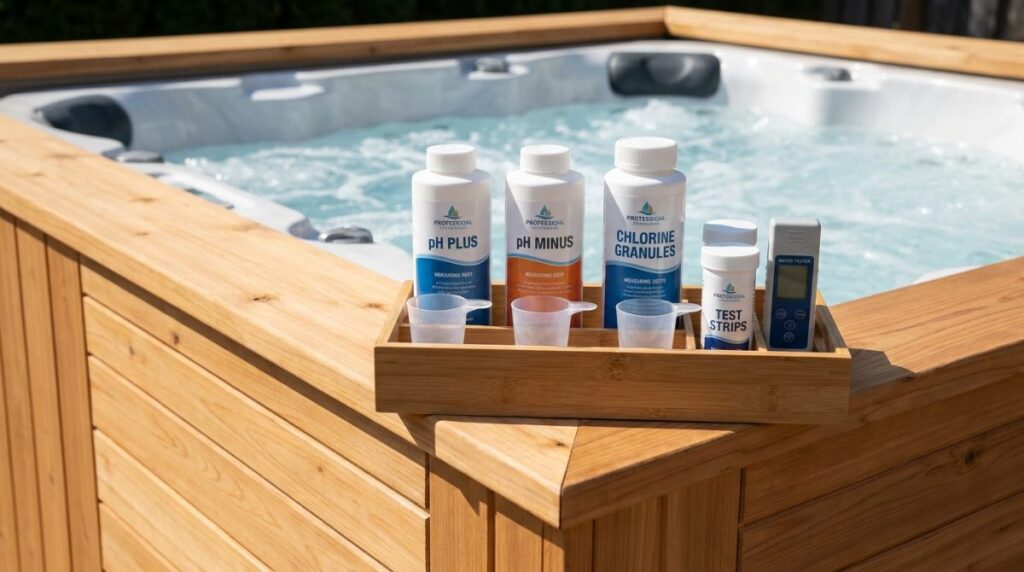
| Test strips / tester | measuring pH, free chlorine or bromine, alkalinity | before bathing, at least once a week |
| pH minus (sodium bisulphate) | lowering the pH | according to the test |
| pH plus (sodium carbonate) | raising the pH | according to the test |
| Alkalinity increaser (sodium bicarbonate) | stabilising the pH | according to the test |
| Chlorine (granules, tablets) | sanitation | continuously, target at least 3 mg/l |
| Bromine | sanitation, an alternative to chlorine | continuously, target 4–8 mg/l |
| Non-chlorine shock (oxidiser) | breaking down organic contaminants | after heavy use, when the water is cloudy |
| Filter cleaner | chemical cleaning of the cartridge | monthly |
| Waterline cleaner | removing biofilm | monthly, when draining |
| Anti-foam | suppressing foam | only temporarily, the cause must be removed |
Swimming pool chemicals are dosed for a different volume and a lower temperature. Use products intended for hot tubs and dose them according to the volume of your tub.
Cloudy or milky hot tub water: what to do
Cloudy or milky water most often has these causes: low sanitiser levels, high pH, a clogged filter or a large amount of organic matter from skin and cosmetics.
Procedure:
- Test the pH and the sanitiser level.
- Adjust the pH to the range of 7.2–7.8.
- Use a non-chlorine shock and let the circulation run.
- Clean or replace the filter.
- If the water does not clear within 1–2 days, change it.
Greenish water indicates algae; brownish or reddish water indicates metals from the fill water. If discolouration recurs, have the fill water tested.
The most common mistakes
- Mixing chemicals. Never mix products with each other or add them at the same time.
- Dosing with the circulation switched off. A concentrated dose in one spot can damage the surface of the liner.
- Testing immediately after dosing. The result is distorted.
- Anti-foam instead of a solution. Foam indicates organic contaminants; the solution is a shock treatment or a water change.
- A neglected filter. The cheapest task with the greatest effect on water clarity.
- A full tub during frost without heating. Always drain a tub that is not kept warm by electric heating, and a tub with a wood-fired heater, before frost.

When to call a service technician
- the control unit reports an error that a restart does not clear,
- the heater does not reach the set temperature,
- the pump is noisy or leaking,
- water appears under the tub.
Repairs, seasonal maintenance and spare parts are provided by the hot tub servicing team. Models and their equipment are listed in the hot tubs category.
You may also be interested in
- Hot tub in winter: operation, frost protection and consumption
- A hot tub at home: who it helps and when to take care
- Heated tub or cold plunge tub
Sources
- CDC: Preventing Hot Tub Rash – free chlorine at least 3 mg/l, bromine 4–8 mg/l, pH 7.0–7.8
- CDC: Controlling Legionella in Hot Tubs – free chlorine 3–10 mg/l, bromine 4–8 mg/l, pH 7.2–7.8, testing frequency, scrubbing surfaces, water change formula, filter maintenance
- Model Aquatic Health Code (MAHC), pH section: cmahc.org – proportion of hypochlorous acid at pH 7.5, effectiveness compared with the hypochlorite ion