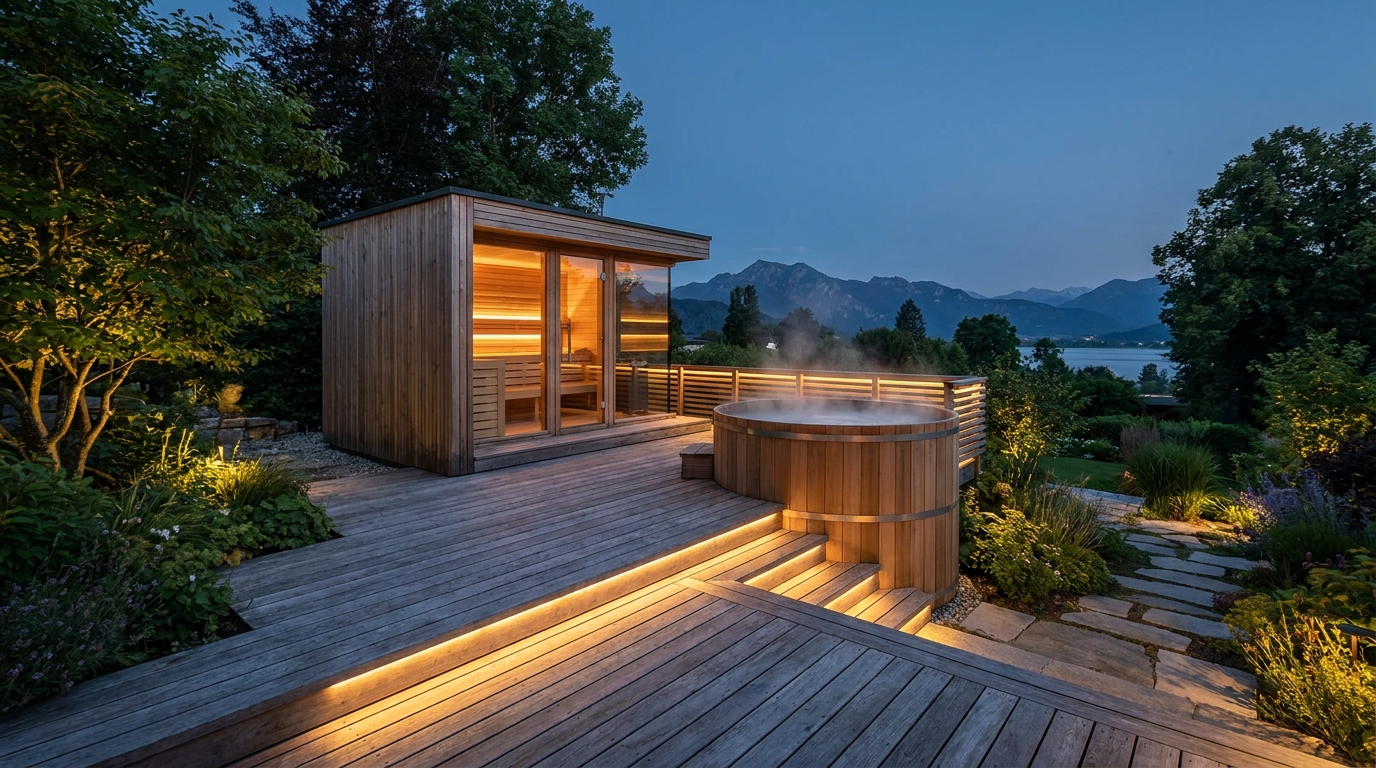
Sauna vs hot tub – the order is decided not by appearance, but by purpose. A sauna works with hot air, typically 70–100 °C, and with short cycles of heating and cooling. It suits those who want a regular heat load several times a week. A hot tub – in the LUXURELAX range, a heated bathing tub with optional hydromassage – works with water at around 36–40 °C and a longer stay. It suits several people at once and a calm phase in the water. If you plan to have both, design them as one whole from the start.

Sauna vs hot tub compared
| Parameter | Outdoor Finnish sauna | Heated bathing tub (hot tub) |
|---|---|---|
| Principle | hot air, steam after water is poured on the sauna stones | warm water, optional hydromassage and air bubbles |
| Operating temperature | typically 70–100 °C | bathing temperature around 36–40 °C |
| Type of use | short cycles alternating with cooling | a longer continuous stay in the water |
| Capacity in our range | from 2 people (e.g. Nordic Pod); larger models according to the product page | 2 to 9 people depending on the chosen tub size |
| Heating | electric Harvia heater or wood-burning heater, configured and added by type | electric heater or wood-burning heater (external or integrated) |
| Preparation | heating the cabin; the time depends on heater output and cabin volume | heating the water with a wood-burning heater takes approximately 1–2 h, depending on the initial water temperature and tub size |
| Infrastructure | a level load-bearing base, a supply matched to heater output, or a flue for a wood-burning heater | a load-bearing base sized for the weight of the water, water supply and drainage |
| Maintenance | airing and drying after use, protection of the timber outdoors | water quality, cleaning the liner, filter maintenance where filtration is fitted |
| Winter | airing and drying the cabin | drain for winter; leave water in only if kept warm by electric heating; a wood-fired tub is always drained in frost |
| Base price in the online shop | outdoor saunas from €3,612 to €36,321 | heated tubs from €1,421 to €5,199 |
Prices are the base configurations of the models in the online shop, including VAT, as of 26 September 2026. Sauna prices exclude the heater. The heater is configured and added by type – an electric Harvia heater or a wood-burning heater, with output matched to the cabin volume. The exception is the largest model, Aurora Grand, which includes a QUBE PRO 360 electric heater with heater protection. The price of the sauna includes free commissioning (connection to the mains, heater connection, testing and a handover of operation). Assembly of the sauna structure costs €390 on models where the product page states it, for example Nordic Pod. The final price depends on the chosen equipment.
What happens in the body: hot air and warm water
Sauna: a short, intense heat load
In a sauna, body temperature rises, the blood vessels in the skin dilate and the heart works faster. The body responds much as it does to light physical exercise. Cooling follows – a shower, a cold tub or time in the open air – and then a rest phase in which the body returns to balance.
The most frequently cited long-term data come from Finland. A prospective study followed 2,315 men aged 42–60 over a median follow-up of 20.7 years. Men who used a sauna 4–7 times a week had half the risk of death from cardiovascular disease (HR 0.50) compared with men who used a sauna once a week (Laukkanen et al., 2015). This is an association, not proof of cause. For recovery, however, one point is essential: the effect is linked to regularity.
Warm water: buoyancy and a longer stay
In water, buoyancy carries part of the body’s weight, so time in a tub is physically less demanding than time in a sauna. The water temperature is lower, the stay longer and the body warms up more slowly.
A laboratory study of 20 young adults with a sedentary lifestyle used 8 weeks of immersion in water at 40.5 °C, 4–5 times a week. The immersion group showed better function of the vascular lining, lower arterial stiffness and lower mean arterial pressure (from 83 to 78 mmHg) (Brunt et al., 2016). The protocol was more intensive than typical bathing at home, so treat the result as a direction, not a promise.
This text is for information only and does not replace consultation with a doctor. If you have a heart or circulatory condition, are pregnant or take medication, consult your doctor before regular sauna use or bathing in hot water.
When to start with a sauna
A sauna is a sensible first step if:
- you want a short heat cycle several times a week and will use the installation regularly,
- you prefer not to manage filling, changing and monitoring water,
- you plan for cooling – a cold shower or a cold plunge tub,
- you are equipping a holiday rental, guesthouse or accommodation – the cabin only needs to be aired and dried after each use.
Advantages: no water management, a stable environment with controlled temperature, and long-term functionality of the timber structure with correct ventilation. Most outdoor saunas can be fitted with an electric Harvia heater or a wood-burning heater – the heater type also determines the supply requirements.
Limitations: a higher entry price, the need for separate cooling and a high temperature that does not suit everyone. What makes up the price is covered in the article how much does a sauna cost. If you are also considering an infrared cabin, see the comparison of a sauna heater and an infrared cabin.
When to start with warm water
A heated bathing tub is a sensible first step if:
- you want a longer stay in the water and time together for several people – Nordic Halo, for example, holds 6–9 people depending on the chosen size, with a volume of 1,400–1,700 l,
- you are looking for a lower entry point – heated tubs start at €1,421 in the online shop,
- you do not want an electrical supply – the tub is heated by a wood-burning heater, but in frost it is drained after bathing,
- you have less space – an oval ofuro-type tub for 2 people occupies 120 × 205 cm.
Advantages: a lower initial investment, use by several people, and optional equipment as needed – hydromassage, air bubbles, insulation, a cover, sand filtration or an electronic temperature controller.
Limitations: with a wood-burning heater, the water takes approximately 1–2 hours to heat, depending on the initial water temperature and the size of the tub, so a bath needs to be planned in advance. Water quality must be monitored and the water regularly changed or filtered – the procedure is described in hot tub maintenance step by step. The tub is drained for winter. Water may only be left in it during frost if it is kept warm by electric heating; a tub with a wood-burning heater is always drained in frost. Details are covered in the article hot tub in winter. An overview of all models is in the hot tubs category.
Sauna vs hot tub: a decision guide
| If… | Start with… |
|---|---|
| You want to use it often and briefly, alone or as a couple | a sauna |
| You want to bathe less often, but for longer and with more people | a bathing tub |
| Water supply or drainage on the plot is a problem | a sauna |
| You prefer to avoid an electrical supply | a tub with a wood-burning heater or a wood-fired sauna |
| The budget for the first step is up to €2,500 | a bathing tub |
| You want a complete cycle of heat and cold | a sauna and a cold tub; add a heated tub later |
| You are equipping accommodation for guests | a sauna; consider a tub according to your capacity to manage the water |

Both at once: a sauna and a tub in one layout
A sauna and a warm tub are not mutually exclusive. They form two phases of one heat cycle: intense heating in the sauna, cooling, and a calm phase in the water. If you plan to have both, decide on the layout right at the start. A shared load-bearing base, a single route for the electrical installation and a shorter path between the two are structurally simpler than later alterations.
A solution in which both elements are combined into one unit is described in the glossary entry 2-in-1 sauna and hot tub combination. If the layout is to stand under a roof, a comparison of cover options is in the article pergola vs garden shed.
Infrastructure to ask about before ordering
- Base: level and load-bearing. For a tub, allow for the weight of the structure, the water and the bathers.
- Electricity: for a sauna with an electric heater, a supply with circuit protection sized to the heater output, specified by an electrician; for a tub, only with an electric heater, hydromassage or filtration.
- Water: a tub needs a supply for filling and a place to drain into. A sauna needs no water.
- Clearances: a wood-burning heater needs a flue and safe distances from combustible materials.
Next step
The technical parameters of individual models are listed in the outdoor saunas and hot tubs categories. Running costs can be estimated as a model calculation in the sauna running costs calculator and the hot tub running costs calculator. We prepare the configuration on request – send us your requirements via the contact form.
You may also be interested in
- Hot tub at home: who it helps and when to be careful
- Sauna and muscle recovery after sport
- Sauna heater vs infrared cabin
Sources
- Laukkanen T, Khan H, Zaccardi F, Laukkanen JA. Association Between Sauna Bathing and Fatal Cardiovascular and All-Cause Mortality Events. JAMA Internal Medicine. 2015;175(4):542–548. DOI: 10.1001/jamainternmed.2014.8187, PubMed: 25705824
- Brunt VE, Howard MJ, Francisco MA, Ely BR, Minson CT. Passive heat therapy improves endothelial function, arterial stiffness and blood pressure in sedentary humans. The Journal of Physiology. 2016;594(18):5329–5342. DOI: 10.1113/JP272453, PubMed: 27270841