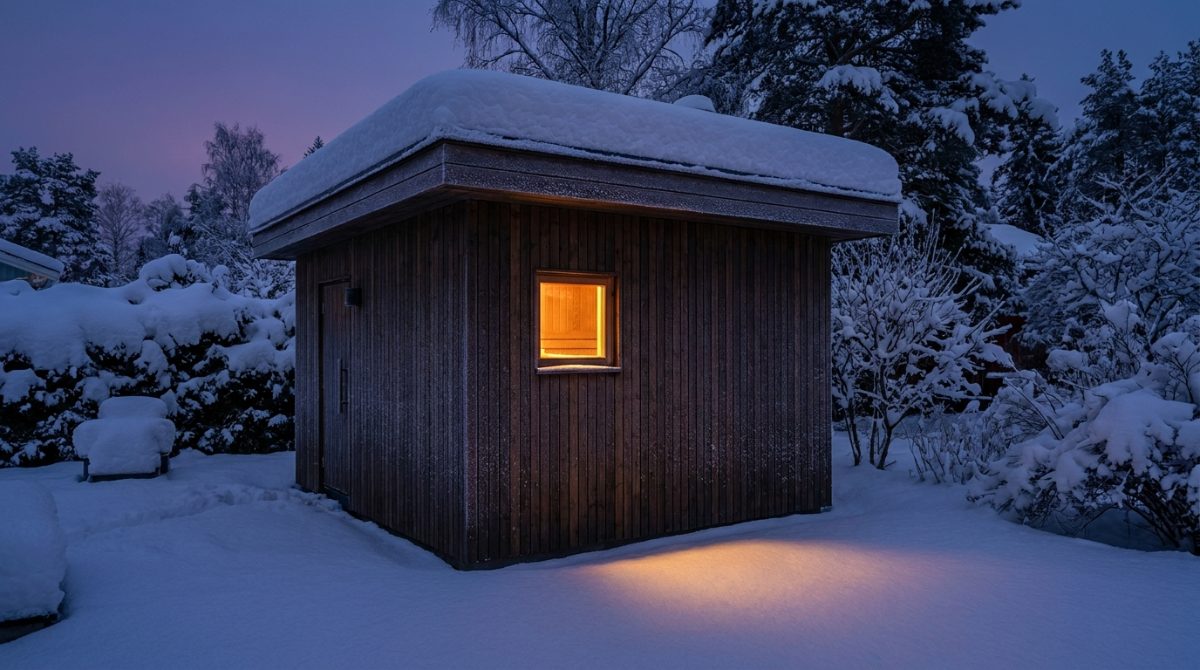
A winter sauna works just as reliably as in summer, but it uses more electricity. The reason is physical: with a cabin temperature of 85 °C and −10 °C outside, the temperature difference is 95 °C instead of 70 °C in summer, and heat losses increase in proportion to this difference – by roughly a third. How much of this you pay for depends on the insulation of the structure, the output of the heater and the way the sauna is operated.
In brief:
- At −10 °C outside, the heat losses of a sauna are approximately 36 % higher than at +15 °C.
- According to a model calculation from the sauna running costs calculator, one sauna session with a 9 kW Harvia heater uses 12–17 kWh, depending on the heating time.
- The greatest influence on winter consumption comes from the insulation of the roof and floor and from how long the door is left open.
- During frost, it is more important than at any other time to let the cabin dry out after each session.
Why a sauna uses more energy in winter
Heat escapes through the walls, roof, floor and windows, and every time the door is opened. With the same insulation, the amount of heat passing through the structure is proportional to the temperature difference between the cabin and its surroundings. The heater has to replace this loss continuously.
| Outdoor temperature | Difference from a cabin at 85 °C | Heat losses compared with summer (+15 °C) |
|---|---|---|
| +15 °C | 70 °C | 100 % |
| 0 °C | 85 °C | approximately 121 % |
| −10 °C | 95 °C | approximately 136 % |
| −20 °C | 105 °C | approximately 150 % |
Calculation: ratio of the temperature differences for the same structure. It does not include wind or door openings, which increase losses further.
Heating up adds to this. In winter, the heater has to warm not only the air but also the timber, benches and stones, which start at the ambient temperature – for example −10 °C instead of +15 °C. Heating up therefore takes longer. By how much depends on the specific model, its insulation and the output of the heater.
The structure decides: solid wall or PAROC insulation
The current LUXURELAX range includes three structural approaches. All are designed for year-round use, but they behave differently in winter.
| Structure | Examples from the range | What it means in winter |
|---|---|---|
| Solid 44 mm wall of spruce or thermally modified timber, without additional insulation | Forest barrel saunas, Nordic Loft, Nordic Span, Arctic Pod, Arctic Cabin, Arctic Shell | solid timber stores heat, but losses are higher; allow for longer heating times |
| Solid 44 mm wall + 5 cm of PAROC mineral wool | Arctic Therm | lower losses through the walls and shorter heating compared with solid timber alone |
| Wall with 10 cm PAROC insulation, insulated roof and floor | Nordic Cube, Aurora Vista (17 cm walls) | the most stable temperature and the lowest losses; suitable for frequent winter use and commercial operation |
The roof and the floor are where the most heat escapes. Warm air rises, and the floor draws cold from the ground. A thicker layer is therefore used there, typically PAROC 10 cm insulation, while PAROC 5 cm is often sufficient for the walls. On large-format models, the ceiling and floor insulation goes up to 150 mm. Stone wool is non-combustible and, with a correctly installed vapour barrier, retains its insulating properties over the long term.
If you use the sauna frequently in winter or operate it for guests, for example in a holiday rental or a guesthouse, an insulated structure pays back through lower consumption and a more stable temperature every time it is used.

Heater output and heating up in frost
The heater output is sized according to the volume of the cabin. The rule of thumb used by sauna equipment manufacturers is approximately 1 kW per 1 m³ of insulated cabin. Glazed areas, thinner insulation and an outdoor location push the required output upwards (details in the glossary entry sauna heater).
Examples from the range:
- smaller cabins for 2 people, for example Nordic Pod: Harvia Top Steel 6 kW (400 V) or Harvia Vega 6 kW (230 or 400 V) electric heaters,
- cabins for 2–4 people, for example Nordic Nest: Harvia Top Steel 9 kW or Harvia Vega 9 kW,
- larger models: output according to volume and configuration; on models with a wood-fired option, a wood-fired heater with an insulated chimney.
A heater with a higher output heats the cabin faster, but total electricity consumption depends mainly on how much heat the structure loses. An undersized heater will not reach the required temperature in frost, or will take an unreasonably long time to heat up.
How much electricity a winter sauna uses per session
The sauna running costs calculator on our website calculates consumption as follows: during heating up, the heater runs at full output; during the session, the thermostat holds it at approximately 50 % of its output. Below are the results of a model calculation for a 75-minute session and a model electricity price of €0.22 per kWh (the calculator’s default assumption – your tariff may differ):
| Heater | Heating up | Consumption per session | Cost per session |
|---|---|---|---|
| Harvia 6 kW | 45 min | 8.3 kWh | approximately €1.82 |
| Harvia 6 kW | 60 min (winter scenario) | 9.8 kWh | approximately €2.15 |
| Harvia 9 kW | 45 min | 12.4 kWh | approximately €2.72 |
| Harvia 9 kW | 60 min (winter scenario) | 14.6 kWh | approximately €3.22 |
| Harvia 9 kW | 75 min (winter scenario) | 16.9 kWh | approximately €3.71 |
Model calculation according to the calculator: kWh = rated output × heating time + rated output × session time × 0.5. The winter heating times are illustrative, not measured. In frost, the thermostat switches the heater on more often during the session, so actual consumption may be higher than the 50 % in the model. The upper limit is always rated output × total time: a 9 kW heater draws a maximum of 18 kWh in 2 hours.
With two sessions a week and a 9 kW heater, the model calculation gives approximately 107 kWh a month with 45 minutes of heating and approximately 127 kWh with 60 minutes. You can recalculate the result for your own tariff, number of sessions and specific model in the calculator. The most accurate figure comes from a sub-meter on the sauna’s power supply.
How to reduce consumption in winter
- Heat up using a timer. A control unit with a timer starts the heater so that the cabin is ready at the planned time. There is no unnecessary waiting at full output.
- Do not use the sauna at 100 °C. At −10 °C outside, 85 °C instead of 100 °C means a temperature difference of 95 °C instead of 110 °C – approximately 14 % lower losses.
- Open the door only briefly. Each time the door opens, the warmest air escapes. Models with an entrance room act as a thermal buffer.
- Do not keep the sauna heated “in reserve”. With occasional use, it is more economical to heat the cabin before each session.
- Pay attention to airtightness. Check the door, windows and roof junctions before winter. A leak costs more in winter than in summer.
- Consider a wood-fired heater. On models with an optional wood-fired heater, firewood replaces electricity. The calculator can also work out this option. See wood-fired saunas.

Protecting the timber and the structure during frost
Timber moves with moisture and temperature. Water that freezes inside it expands and damages both the surface and the joints. Winter protection therefore rests mainly on keeping moisture out of the structure.
- Ventilate after every session and let the cabin dry out. A door left ajar and working ventilation remove moisture before it condenses in the cold structure.
- Keep the drain clear. Water left in the trap or under the duckboards freezes in frost. Before winter, check that the drain is not blocked.
- Treat the exterior surface before winter. Thermally modified timber has lower water absorption and higher dimensional stability after heat modification. It is treated only with an oil containing a UV filter so that it keeps its colour – without it, it naturally turns grey. Spruce cladding outdoors is protected by a wood stain. In exposed positions, it is usually renewed every 2–4 years; on sheltered sides, out of the wind or under a roof overhang, it can last 5 years or more. The exact interval is set by the coating manufacturer and the condition of the surface: once water stops beading on the surface, it is time for a new coat. Siberian larch is naturally more resistant.
- Keep an eye on snow on the roof. Remove a heavier layer of snow, especially wet snow, by hand without sharp tools so as not to damage the roof covering.
- The base. Saunas are placed on a level, firm surface. Uneven settlement of the base after freezing shows up in the door and the joints.
How long the structure lasts with correct maintenance is covered in the article on sauna construction quality and service life.

Safety and electrical installation
- The electrical installation for sauna heaters is governed by the European standard HD 60364-7-703 (IEC 60364-7-703) for rooms and cabins containing sauna heaters, as adopted in national wiring regulations – in the United Kingdom, section 703 of BS 7671. The heater must be connected and inspected by a qualified electrician. A 400 V heater needs a three-phase supply; Harvia Vega heaters can also be connected to 230 V. The electrician determines the circuit protection and cable cross-section according to the heater manufacturer’s instructions.
- The path to the sauna ices up in winter. Plan for a non-slip surface and path lighting.
- Check the temperature with a thermometer by the bench. The control unit measures at the sensor position, not where you sit.
- Regular servicing before the winter season includes checking the heater, stones, seals and drain. See sauna servicing.
Next step: you can calculate the consumption for your model, tariff and number of sessions in the sauna running costs calculator. The insulation and heater parameters of the individual models are listed in the outdoor saunas category.
You may also be interested in
- Hot tub in winter
- Outdoor sauna price: what determines the investment
- Sauna and muscle recovery after sport
Sources and references
- LUXURELAX product pages (WooCommerce, verified 26 September 2026): Nordic Pod, Nordic Nest, Nordic Haven – Harvia Top Steel / Vega 6 and 9 kW heaters; Arctic Therm – PAROC 5 cm; Nordic Cube, Aurora Vista and others – PAROC 10 cm; Forest Loop/Ring/Orbit, Nordic Loft/Span, Arctic Pod/Cabin/Shell – solid 44 mm wall; Nordic Hall – PAROC 150 mm ceiling and floor.
- LUXURELAX sauna running costs calculator – calculation assumptions (full output during heating up, approximately 50 % during the session, model electricity price of €0.22/kWh).
- LUXURELAX glossary – sauna heater (1 kW per 1 m³), PAROC 5 and 10 cm insulation.
- IEC 60364-7-703:2004 / HD 60364-7-703:2005 – Low-voltage electrical installations, Part 7-703: Requirements for special installations or locations – Rooms and cabins containing sauna heaters.
- Abodo, How often do I need to stain timber cladding – exposed sides 2–4 years, sheltered 5 years or more: abodowood.co.uk
- efarby.sk, Drevo – exteriér / odpovede špecialistu (in Slovak) – with standard coatings on the sunny side, renewal after approximately 3 years, high-quality systems 6 years or more: efarby.sk